
What Is Mangal Dosha? How Manglik Is Judged and When It Is Cancelled
2026-07-24 · 7 min read
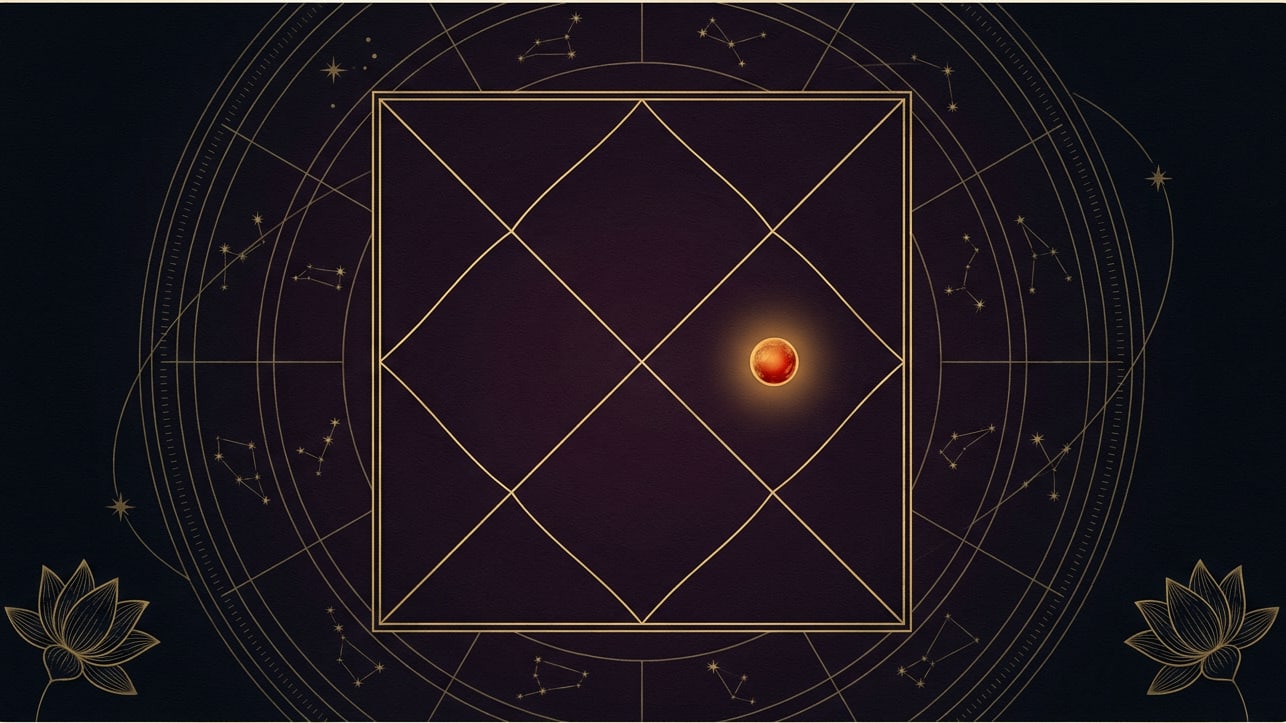
Mangal Dosha, being Manglik, means Mars occupies the 1st, 2nd, 4th, 7th, 8th or 12th house counted from your Lagna, your Moon or Venus. Classical Jyotish reads it as extra heat pressing on married life, not as a sentence on it, and the same tradition that names the dosha also lists many conditions under which it stands cancelled.
Few words in Indian astrology frighten families more than this one. Much of that fear comes from the word being used as a label rather than as a measurement. In a proper reading it is neither, it is one observation inside a whole chart.
What is Mangal Dosha in Vedic astrology?
Mars, Mangal, is the graha of energy, courage, drive and conflict. It is a natural malefic in Jyotish, which does not mean evil, it means it works by pressure and friction rather than by ease.
When Mars sits in a house that governs the self, the home, the marriage, the longevity of the union or its expenses, the classical view is that its heat falls on the married life. The Brihat Parashara Hora Shastra, the foundational text of the Parashari method (on the classical texts of Hindu astrology), discusses Mars in the 7th and 8th houses in exactly this spirit: as a placement that asks for care in partnership, not one that forbids it.
The same condition is called Kuja Dosha in the South and Chovva Dosham in Kerala. It is one dosha under three names.
Which houses make a person Manglik?
Six houses are counted, and they are counted three times over: from the Lagna (ascendant), from the Moon sign, and from Venus. The Lagna is the primary reference; the Moon shows the emotional life and Venus signifies marriage itself, which is why both are checked.
| House | What it governs | Why Mars there is noted |
|---|---|---|
| 1st | The self, body, temperament | Sharpness and impatience carried into the partnership |
| 2nd | Family, speech, accumulated wealth | Blunt speech and friction within the wider family |
| 4th | Home, mother, domestic peace | Restlessness at home, difficulty settling |
| 7th | Marriage, spouse, partnership | The most directly noted placement of all |
| 8th | Longevity, in-laws, shared resources | Traditionally the heaviest reading, worry over the union's stability |
| 12th | Bed, expenditure, distant places | Separation by distance, strain on intimacy and spending |
Notice that the 3rd, 6th and 11th houses are absent. Mars is actually considered to do well in those, which is a useful reminder that this is a placement question, not a verdict on the planet.
Where Mars falls in only one of the three reference charts, many astrologers call it Anshik or partial Manglik. Where it repeats from the Lagna, the Moon and Venus together, it is read as full or Purna Manglik. Most people described as Manglik in matrimonial listings fall in the first group.
When is Mangal Dosha cancelled?
This is the part that rarely reaches the family reading out the word from a matching report. Classical practice contains a long list of cancellation conditions, called Mangal Dosha Bhanga. The widely used ones are these.
- Mars in its own sign. Mars in Aries or Scorpio is at home, and a graha in its own house behaves with far more restraint.
- Mars exalted. Mars in Capricorn is exalted and reads as disciplined force rather than raw heat.
- Jupiter's association. Jupiter conjunct with or aspecting Mars is the single most quoted mitigation, because Jupiter's nature is to counsel and to steady.
- Venus and Jupiter strong in the angles. A strong Venus, the significator of marriage, materially reduces the concern.
- Saturn in the same six houses. Saturn placed in the 1st, 4th, 7th, 8th or 12th is held to blunt the effect, one malefic checking another.
- Both partners Manglik. Where both charts carry the dosha, the tradition treats them as balanced. This is the most commonly applied rule in practical matching.
- Mars combust, debilitated or weak. A Mars without the strength to act cannot deliver a strong result, for good or ill.
No two astrologers use an identical list, and honest practice admits that. What matters is that the tradition never intended the dosha to be read as a permanent, uncancellable mark.
Does being Manglik really ruin a marriage?
No. The popular belief that a Manglik will bring harm or early widowhood to a non Manglik spouse has no support in the classical method, and it has caused real damage: forced tree marriages, broken engagements and quiet distress in young people who did nothing but be born at a certain hour. The practice has been publicly criticised on exactly these grounds, and that criticism deserves a straight answer rather than a defensive one.
What the tradition actually says is narrower and more useful. Mars in these houses describes a temperament: forceful, impatient, quick to speak, slow to yield. Marriages struggle over those qualities, and a chart that flags them early is doing its job. That is guidance, not prophecy. A chart is a diagnosis, never a sentence.
There is also a timing dimension that gets lost entirely. Difficulty tends to surface when a Mars Mahadasha or Antardasha is running, and to recede when it passes. A dosha read without its Dasha is half a reading.
How should Mangal Dosha be handled in a real matching?
A dosha is checked inside the full match, never on its own. In practice the sequence is:
- Cast both charts accurately from the birth date, time and place.
- Note Mars from the Lagna, the Moon and Venus in each chart.
- Apply the cancellation conditions honestly, in both directions.
- Read the 7th house, its lord, Venus and Jupiter for the actual quality of the married life.
- Compare the Dasha sequences, because compatibility that ignores timing is theoretical.
- Only then read it alongside the Guna Milan score, which measures something different again.
If you want to see how much else a chart carries beyond this one placement, what your Kundli actually reveals covers the wider ground.
What are the traditional remedies for Mangal Dosha?
Remedies in Jyotish are disciplines, not switches. They are offered as support, and no honest astrologer will promise a specific outcome from them. The classical ones for Mars are:
- Recitation of the Mangal or Hanuman mantra, commonly on Tuesdays.
- Charity in the significations of Mars: red lentils, jaggery, blood donation.
- Fasting or a lighter Tuesday routine, kept consistently rather than intensely.
- A red coral, but only if the whole chart supports it, since a gemstone strengthens a planet and a strong Mars is not always what a chart needs.
Note the caution on the coral. Strengthening Mars when Mars is already the pressure point can make matters worse, which is why gemstones should never be bought off a report. Where the difficulty is temperamental rather than astrological, the remedy is temperamental too: patience, plain speech and restraint do more for a Mars-heavy marriage than any stone.
The honest summary
Being Manglik is a real observation in the classical method and a badly misused one in practice. It describes pressure on the married life from a fiery graha, it comes with a long list of cancellations, it is read jointly with the 7th house and the Dasha, and it has never meant that someone should not marry. If a report has labelled you or your family, the useful next step is a full reading rather than a second opinion on the label. You can see what a full marriage matching covers before you book.
Frequently asked questions
- What is Mangal Dosha?
- Mangal Dosha, also called Manglik Dosha or Kuja Dosha, is the condition in which Mars occupies the 1st, 2nd, 4th, 7th, 8th or 12th house counted from the Lagna, the Moon or Venus in a birth chart. Classical Jyotish reads it as extra heat and force pressing on the married life, which can show as friction, impatience or separation if the rest of the chart supports that reading.
- How do I know if I am Manglik?
- It is checked from your exact date, time and place of birth, because the Lagna changes roughly every two hours. An astrologer casts the chart, finds Mars, and counts its house position from three reference points: the Lagna, the Moon and Venus. If Mars falls in one of the six houses from any of them, the dosha is noted, and its strength is then judged rather than simply declared.
- When is Mangal Dosha cancelled?
- The tradition lists many cancellation conditions, known as dosha bhanga. The common ones are Mars in its own sign Aries or Scorpio, Mars exalted in Capricorn, Mars conjunct or aspected by Jupiter, Saturn placed in one of the same six houses, and both partners carrying the dosha. A qualified reading weighs these instead of stopping at a yes or no answer.
- Can a Manglik marry a non Manglik?
- Yes. The tradition treats matching charts for Mars as one factor among many, not as a barrier. Where the dosha is strong in one chart and absent in the other, an astrologer looks at the 7th house and its lord, the strength of Venus and Jupiter, and the running Dasha before advising. Being Manglik is not a disqualification from marriage.
- Does Mangal Dosha end at the age of 28?
- This is a popular belief rather than a classical rule. No standard text switches the dosha off on a birthday. What does change with time is the planetary period a person is running and their own maturity, which is probably what the folk belief is pointing at, but the chart is what should be read, not the age.