
What Your Kundli (Birth Chart) Actually Reveals
2026-07-09 · 7 min read
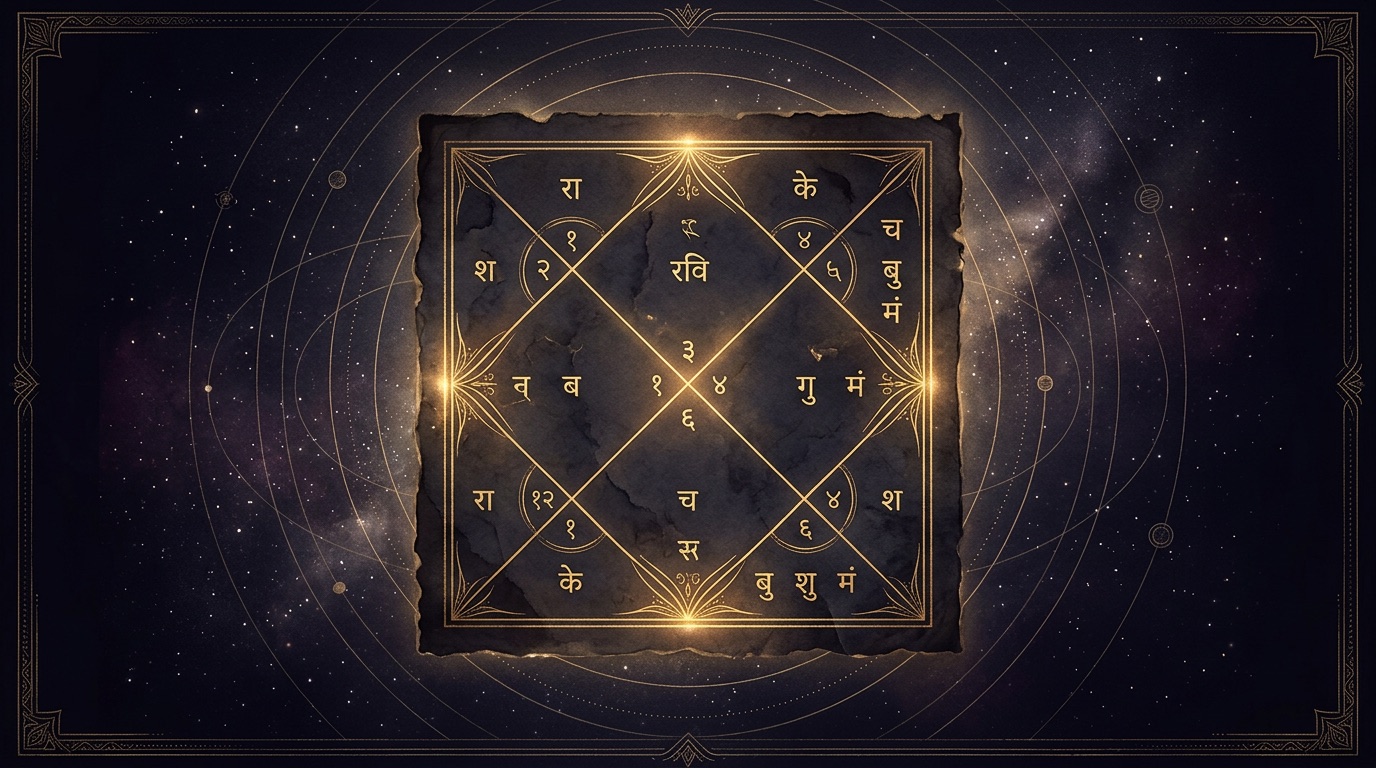
A Kundli, or birth chart, is a map of the sky at the exact moment and place you were born, read methodically to describe your character, the areas of your life and the timing of events. It is not a fortune-telling gimmick but a structured, mathematical record of planetary positions that can be read layer by layer, more like a detailed diagnosis than a single yes-or-no answer. Here is what the main pieces mean and how they combine into a full reading.
What is a Kundli, exactly?
Your Kundli is calculated from three things: your date of birth, your time of birth, and your place of birth. From these, an astrologer works out where every planet stood in the sky and how those positions fall into the framework of signs and houses. Because it is built from precise astronomical data, a Kundli is only as accurate as the birth details you provide, which is why a careful astrologer asks for all three, and asks for the time as exactly as you can give it.
What does the Lagna (ascendant) reveal?
The Lagna is the sign that was rising on the eastern horizon at your birth. It sets the frame for the entire chart, deciding which planets fall in which houses and therefore how the whole reading is organised. The Lagna also describes your outward self: your temperament, your physical constitution and the way you meet the world.
Because the Lagna changes roughly every two hours, an accurate birth time matters enormously. A small error can shift your Lagna into the next sign and rearrange the whole chart, changing the reading substantially. This is why a good astrologer will always ask for your time of birth as precisely as possible, and why a birth certificate or hospital record is worth digging out.
What are your Rashi and Nakshatra?
Your Rashi is your Moon sign, the zodiac sign the Moon occupied at birth. In Vedic astrology it carries more weight for character and emotion than the Sun sign does, which is one of the key differences from Western astrology, and it is the "sign" a Vedic astrologer usually means when they speak of yours. The Moon governs the mind, the emotions and the inner life, so the Rashi is central to understanding how you feel and react rather than merely how you appear. If the overlap between your Lagna, your Rashi and the Western Sun sign is confusing, this guide separates the three.
Your Nakshatra is a finer division still: one of 27 lunar mansions the Moon can occupy, each with its own symbol, ruling planet and temperament. The Nakshatra adds nuance to character that the Rashi alone cannot, and, importantly, it is the starting point for calculating your Dasha, the timing system described below.
What do the twelve houses mean?
The chart is divided into twelve houses (bhavas), each governing an area of life. Where a planet sits, and which houses it rules, tells the astrologer which parts of your life that planet colours. A benefic planet strengthening the house of marriage reads very differently from a difficult planet weighing on the house of health.
| House | What it governs |
|---|---|
| 1st | The self, body and temperament |
| 2nd | Wealth, family and speech |
| 3rd | Siblings, courage and effort |
| 4th | Home, mother and comfort |
| 5th | Children, creativity and learning |
| 6th | Health, obstacles and enemies |
| 7th | Marriage and partnership |
| 8th | Longevity, upheaval and the hidden |
| 9th | Fortune, dharma and higher learning |
| 10th | Career, status and action |
| 11th | Gains, income and networks |
| 12th | Expenditure, loss and release |
The seventh house, for example, is the one an astrologer weighs most closely in Kundli matching for marriage.
What do the planets and nodes (Rahu and Ketu) show?
A Vedic reading works with the seven visible grahas, Sun, Moon, Mars, Mercury, Jupiter, Venus and Saturn, plus the two lunar nodes, Rahu and Ketu. Each planet has a natural character (Jupiter expansive and benevolent, Saturn slow and disciplining, and so on), and each behaves differently depending on the sign and house it lands in — it is Saturn's slow discipline, for instance, that people feel during the seven-and-a-half-year Sade Sati transit. Rahu and Ketu, the nodes, are especially important in Jyotish: they describe the pulls and detachments in a life, the sudden turns and the areas of unusual intensity. Reading a chart well means weighing not just where each planet is, but how the planets relate to one another.
What is the Dasha, and how does it time events?
The Dasha is the layer that answers when. In the Vimshottari system, the most widely used, life is divided into major planetary periods (Mahadasha) and sub-periods (Antardasha), running in a fixed sequence set by your Nakshatra at birth. A Mahadasha can last from six to twenty years depending on the planet; within it, each Antardasha shifts the flavour of the period.
Knowing which planet is currently running, and when it hands over to the next, is how a reading pinpoints favourable and difficult stretches rather than speaking only in generalities. It is the difference between "you will do well in your career" and "the years of your Jupiter period are when your career is most likely to advance." Timing is the part of a Kundli reading people most often come for.
What are yogas in a Kundli?
Certain planetary arrangements form named yogas, combinations that can strengthen or complicate specific results. There are yogas associated with wealth, with learning and eloquence, with leadership and authority, and with hardship. A famous example is the Gaja Kesari Yoga, formed by a favourable relationship between Jupiter and the Moon, traditionally linked to good judgement and reputation. Identifying the yogas present in your chart, and how strong or compromised they are, is part of a full reading, because they modify the promise of the houses and planets.
What a reading does with all this
A complete Kundli reading brings these layers together in order:
- The Lagna frames the chart and describes the outward self.
- The Rashi and Nakshatra reveal the mind and inner temperament.
- The houses locate the themes of your life.
- The planets and nodes colour those themes.
- The Dasha times them, marking the years that matter most.
- The yogas modify the strength of the results.
It then closes with practical remedies for the planets that need support: a mantra, a charitable act, a gemstone or a change in routine. A chart is a diagnosis, not a sentence: the point of reading it is to act on it wisely.
Read your own chart in full
Every Kundli tells a different story, and the value is in reading all the layers together rather than seizing on one placement in isolation. At Astro Anita, readings follow the classical Vedic (Parashari) method, covering Lagna, Dasha, yogas and clear remedies, in Hindi or English, online or in person.
If you would like your own chart read in full, Lagna, Dasha, yogas and the years that matter most, book a Kundli reading with your date, time and place of birth, or browse the consultations to find the reading that fits.
Frequently asked questions
- What details are needed to make a Kundli?
- Three things: your date of birth, your exact time of birth, and your place of birth. From these an astrologer calculates where every planet stood in the sky. A Kundli is only as accurate as the birth details you provide, so the time should be as precise as possible.
- Why does the exact birth time matter for a Kundli?
- Because the Lagna (ascendant) changes roughly every two hours. A small error in the time can shift your Lagna into the next sign and rearrange the whole chart, changing the reading substantially. A birth certificate or hospital record is worth digging out.
- What is the difference between Rashi and Lagna?
- Your Rashi is your Moon sign, the sign the Moon occupied at birth, and it governs your mind and emotions. Your Lagna is the sign rising on the eastern horizon at birth, which frames the whole chart and describes your outward self. Both are read together.
- Can a Kundli predict the future?
- A Kundli is best understood as a diagnosis, not a sentence. Through the Dasha system it points to the years when themes are most likely to unfold, and it closes with remedies. It offers honest guidance and timing rather than fixed, guaranteed predictions.