
What Are Rahu and Ketu? The Shadow Planets in Your Kundli and All 12 Houses
2026-08-04 · 9 min read
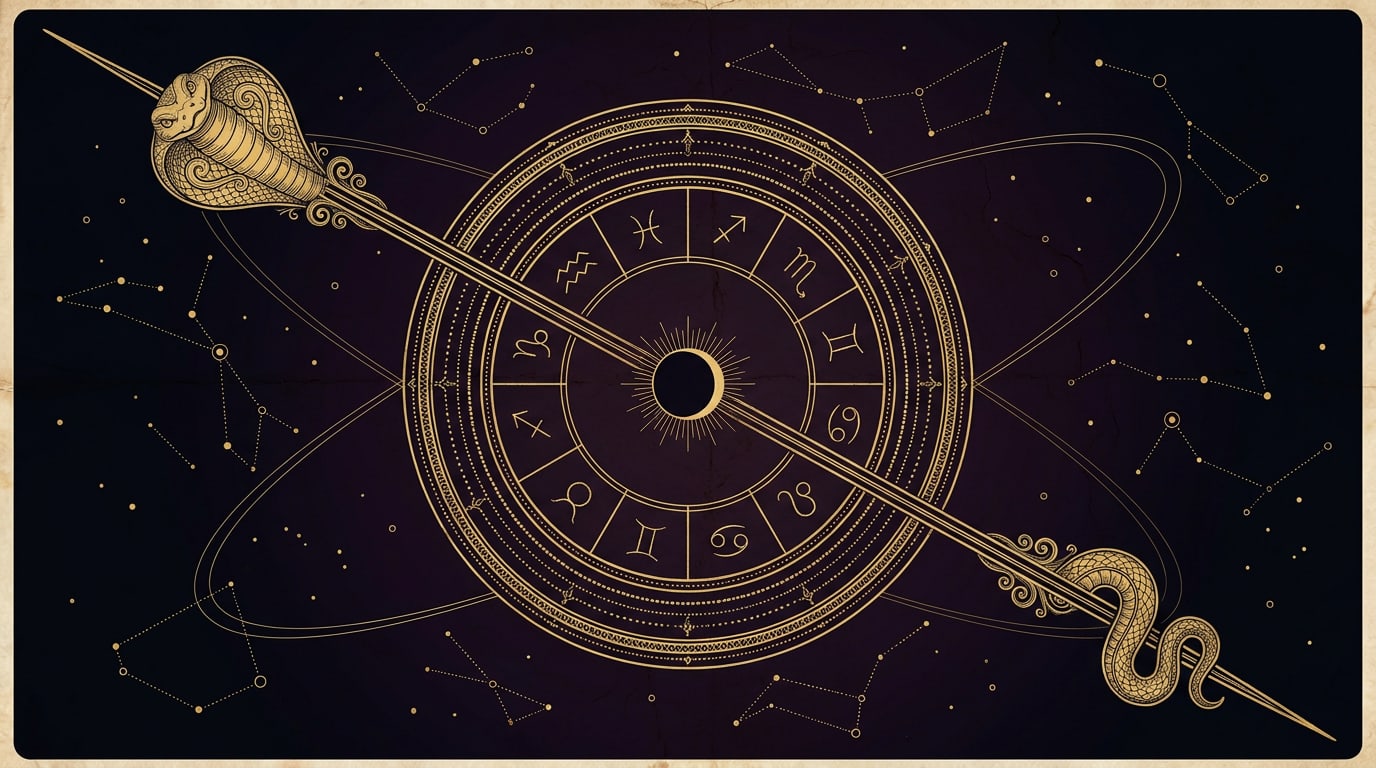
Rahu and Ketu are the two points where the Moon's orbit crosses the Sun's apparent path, so they are shadow points rather than physical planets. They always sit exactly opposite each other in a Kundli, seven houses apart. Rahu marks the direction of unfinished desire and Ketu the ground you have already covered and can let go of.
Together they form a single line through the chart, and Jyotish reads that line as a karmic axis. Nothing in a Vedic chart is asked about more often, and nothing is more often used to frighten people. Here is what the classical method actually says.
What are Rahu and Ketu in Vedic astrology?
Every other graha in a Kundli is a body you can point at in the sky. Rahu and Ketu are not. They are the lunar nodes: the two places where the Moon's tilted orbit intersects the ecliptic, the plane of the Sun's apparent path (lunar node). Rahu is the ascending or north node, Ketu the descending or south node.
This is why the tradition calls them chhaya grahas, shadow planets. Having no physical body, they take on the character of whatever they sit with, and they act by absorption and obsession rather than by ordinary planetary give and take.
The astronomy also explains the myth. Eclipses can only happen when a new or full Moon falls close to one of these crossing points, which is why the eclipse seasons are governed by the nodes (solar eclipse). The story of the severed demon who swallows the Sun and the Moon, head and tail separated forever, is the classical way of describing exactly that geometry.
What is the difference between Rahu and Ketu?
They are two ends of one line, so they work as a pair of opposites: one grasps, the other releases.
| Rahu (north node) | Ketu (south node) | |
|---|---|---|
| Image | The severed head, appetite with no body | The severed body, action with no head |
| Direction | Forward, towards what you have not had | Backward, towards what you have already finished |
| Gives | Ambition, hunger, sudden rise, foreign and modern fields | Detachment, depth, research, insight, spiritual pull |
| Difficulty | Never satisfied, prone to shortcuts and illusion | Indifference, sudden loss of interest, self doubt |
| Signifies | Technology, media, travel abroad, unconventional routes | Moksha, mathematics, healing, ancestral and past life themes |
| Vimshottari Dasha | 18 years | 7 years |
A useful way to hold it: Rahu shows the hunger of this lifetime, Ketu shows the skill you brought with you. Ketu's house is often where a person is quietly excellent and completely uninterested. Rahu's house is where the same person will chase for decades.
Why are Rahu and Ketu always opposite each other?
Because two circles on a sphere can only cross at two points, and those points are always 180 degrees apart. So in every Kundli ever cast, Rahu and Ketu occupy opposite signs and are exactly seven houses apart. Rahu in the 1st means Ketu in the 7th, Rahu in the 4th means Ketu in the 10th, and so on.
Two more properties follow from the same geometry. The nodes always move retrograde, backwards through the zodiac, and they complete one circuit in roughly 18.6 years. That is why a Rahu and Ketu return, when they come back to their birth positions, falls at about age 18 or 19, and again near 37 and 56, ages many people recognise as turning points.
You may also see charts drawn with "mean" or "true" nodes. Mean nodes use a smoothed average motion, true nodes the actual wobbling position. Most Indian software and most classical practice uses the mean node, and the difference is usually small, but it is worth knowing your astrologer's setting.
What do Rahu and Ketu mean in each of the 12 houses?
Because they move as one axis, you read both ends together: the house Rahu occupies is where you are pulled, and the house six signs away, where Ketu sits, is where you are asked to loosen your grip. These are broad classical themes, not predictions; the actual result depends on the signs, the house lords and the Dasha.
| Rahu in house | Ketu in house | The pull, and what is being released |
|---|---|---|
| 1st | 7th | Building a distinct self and image; letting go of dependence on a partner's approval |
| 2nd | 8th | Earning, family, speech; releasing dependence on inherited or other people's money |
| 3rd | 9th | Effort, courage, communication; loosening inherited belief taken on trust |
| 4th | 10th | Home, roots, inner security; easing an over identification with status and career |
| 5th | 11th | Creativity, children, learning; releasing the pull of networks and crowds |
| 6th | 12th | Service, competition, discipline; letting go of withdrawal and escape |
| 7th | 1st | Partnership and the world of others; softening a self contained ego |
| 8th | 2nd | Research, the hidden, transformation; loosening attachment to accumulation |
| 9th | 3rd | Philosophy, teachers, long journeys; releasing restless short term effort |
| 10th | 4th | Public work and responsibility; leaving behind the safety of the childhood home |
| 11th | 5th | Gains, community, large aims; releasing attachment to personal creation |
| 12th | 6th | Retreat, foreign lands, inner life; letting go of endless struggle and conflict |
Note also that the classical texts do not agree on where the nodes are exalted. One tradition gives Rahu exaltation in Taurus and Ketu in Scorpio, another gives Gemini and Sagittarius, and several older texts assign them no exaltation at all. Any astrologer who states one of these as settled fact is skipping over a real disagreement in the tradition.
Are Rahu and Ketu always bad?
No, and this is where most of the fear online is manufactured. The nodes are classed as malefics because they are uncomfortable, not because they are hostile. Rahu placed well can carry a person further than any benefic will, particularly in modern, technical, foreign or unconventional work. Ketu placed well gives the sharp, patient, uninterested-in-applause mind that does real research or real sadhana.
Timing is where the axis becomes practical. Rahu holds an 18 year Mahadasha and Ketu a 7 year one in the Vimshottari Dasha cycle, and those are usually the periods in which their themes become unavoidable. A Rahu Mahadasha with a strong Rahu is a very different eighteen years from the same period with an afflicted one, which is exactly why the generic articles cannot answer the question and a properly read chart can.
What about Kaal Sarp Dosh and Grahan Dosh?
Kaal Sarp Dosh is the name given to a chart in which all seven visible grahas fall on one side of the Rahu to Ketu axis. Grahan Dosh describes the Sun or Moon sitting closely with a node. Both patterns are real and both are worth reading carefully.
What is not classical is the terror attached to them. Kaal Sarp Dosh does not appear in Brihat Parashara Hora Shastra or Phaladeepika; it is a modern construct that spread through the twentieth century and has become one of the most heavily monetised labels in Indian astrology, with expensive pujas sold on the strength of a word. Senior astrologers have been publicly critical of it for decades.
The honest position is straightforward. If all your planets happen to sit on one side of the axis, that concentration is worth reading, in the same way that any concentration in a chart is worth reading. It is not a curse, it does not doom a marriage or a career, and it does not require an expensive ritual in a distant town. The same applies to fear-based claims around Mangal Dosha: a chart is a diagnosis, not a sentence.
What are the traditional remedies for Rahu and Ketu?
Traditional remedies are deliberately modest, and none of them promises an outcome. Their purpose is to help you meet the period consciously rather than to bend it.
- Mantra, the Rahu and Ketu beej mantras or the Maha Mrityunjaya, done steadily rather than intensely for a week.
- Daan, charity of the items each node signifies, given quietly and regularly.
- Discipline and routine, which matter more in node periods than in any other, because Rahu's characteristic failure is the shortcut and Ketu's is drift.
- Honest dealing, especially in Rahu periods, where the temptation is to gain by a route you would not describe out loud.
- Gemstones, only after a full reading, never on the strength of a birth date alone. Hessonite for Rahu and cat's eye for Ketu are prescribed far more often than they are warranted.
Astrology is offered here as guidance rather than guaranteed prediction, and no remedy substitutes for medical, legal or financial advice.
How do you find where Rahu and Ketu sit in your chart?
You need your date of birth, your exact time of birth and your place of birth. From these the nodes are calculated along with everything else, and any free calculator will give you their signs and houses in a few seconds.
What a calculator cannot tell you is what the axis means for you: which houses the nodes rule for your Lagna, who they sit with, whether the Dasha of either is running or approaching, and which of the traditional remedies is actually appropriate. That reading is the substance of a consultation, and it is where the Rahu and Ketu axis stops being a frightening phrase on the internet and starts being a usable map of what you are here to want, and what you can finally put down.
Frequently asked questions
- What are Rahu and Ketu in simple words?
- Rahu and Ketu are the two points where the Moon's path crosses the Sun's apparent path in the sky. They are not physical bodies, which is why Jyotish calls them chhaya grahas, shadow planets. Rahu is the northern crossing point and Ketu the southern one. In a Kundli they mark where desire pulls you forward and where you are already finished and detached.
- Why are Rahu and Ketu always opposite each other?
- Because they are two ends of one straight line. The Moon's orbit is a circle tilted against the Sun's path, and any two circles on a sphere cross at exactly two points, 180 degrees apart. So Rahu and Ketu are always in opposite signs, seven houses apart, and they always move backwards through the zodiac, completing a circuit in about 18.6 years.
- Are Rahu and Ketu always bad in a birth chart?
- No. They are considered difficult rather than evil, and both are capable of giving a great deal. Rahu can carry a person into unusual reach and success, especially in worldly, modern or foreign fields, and Ketu often gives depth, research ability and genuine spiritual progress. What matters is the house, the sign, the lord they sit with and the Dasha running, not the name of the planet.
- How long are the Rahu and Ketu Mahadashas?
- In the Vimshottari system the Rahu Mahadasha runs 18 years and the Ketu Mahadasha runs 7 years, out of the 120 year cycle. Ketu's period comes first in the sequence and Rahu's falls between Mars and Jupiter. Both are usually eventful periods, and how they unfold depends on how the two nodes are placed in your own chart.
- Is Kaal Sarp Dosh real?
- The pattern is real enough as a description: all seven visible grahas falling on one side of the Rahu to Ketu axis. What is not classical is the fear attached to it. Kaal Sarp Dosh does not appear in Brihat Parashara Hora Shastra or Phaladeepika, and a great deal of expensive ritual is sold on the strength of it. A careful astrologer will read the actual placements rather than charge for the label.