
What Is a Nakshatra? All 27 Lunar Mansions, Their Lords and Padas Explained
2026-08-07 · 9 min read
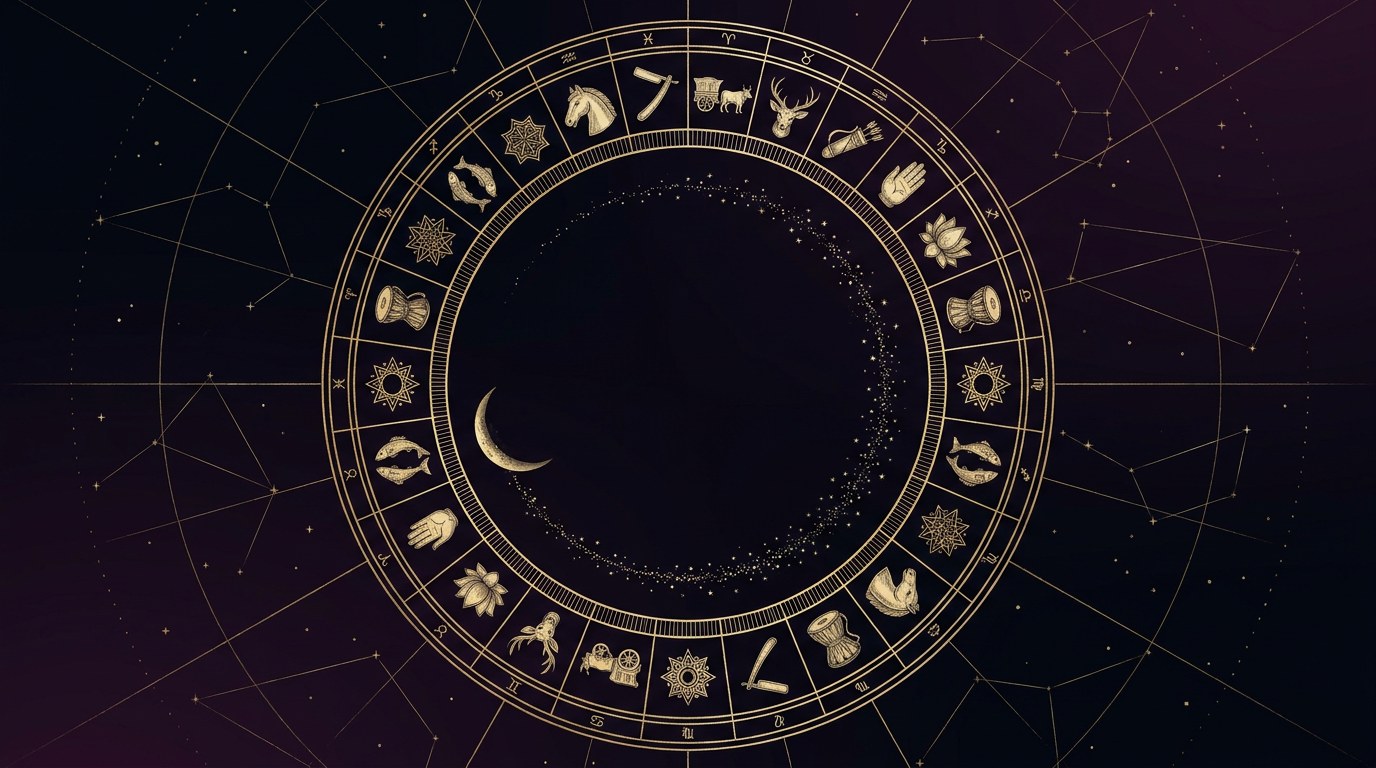
A nakshatra is one of the 27 segments of the sidereal zodiac, each exactly 13 degrees and 20 minutes wide, that the Moon travels through on its monthly circuit. Your janma nakshatra, or birth star, is the one the Moon occupied at the moment you were born. It refines your Rashi, carries its own ruling planet, symbol and deity, and it decides where your Vimshottari Dasha begins.
That last point is the one most articles skip. The nakshatra is not decorative detail. It is the timing engine of the whole chart.
What is a nakshatra in Vedic astrology?
The word joins naksha, a map or a marking, with tra, to guard. The 27 nakshatras are the oldest layer of Indian astronomy, named in the Vedas long before the twelve Rashis entered common use, and they divide the sky by the Moon rather than the Sun.
The arithmetic is simple and worth knowing. The Moon completes one sidereal circuit in roughly 27.3 days, so the sky was divided into 27 equal parts, one for each day of that journey. Divide 360 degrees by 27 and you get 13 degrees 20 minutes per nakshatra. The Moon covers about that much ground every day, which is why your janma nakshatra can change if your recorded birth time is wrong by even a few hours near a boundary.
Two structural points to hold on to:
- Nakshatras are measured on the sidereal zodiac, fixed against the stars, using an ayanamsha correction. Most Indian practice uses the Lahiri (Chitrapaksha) ayanamsha. This is the same reason Vedic and Western astrology give different signs.
- A nakshatra does not respect sign boundaries. Krittika, for example, begins in Mesha and finishes in Vrishabha. Signs and nakshatras are two independent grids laid over the same circle.
What are the 27 nakshatras and their ruling planets?
Every nakshatra has a planetary lord, a symbol and a presiding deity. The lords run in a fixed repeating order of nine, Ketu, Venus, Sun, Moon, Mars, Rahu, Jupiter, Saturn, Mercury, cycling three times to cover all 27. That order is not arbitrary, it is the backbone of the Vimshottari Dasha system.
| # | Nakshatra | Span (sidereal) | Lord | Symbol | Deity |
|---|---|---|---|---|---|
| 1 | Ashwini | 0°00' to 13°20' Mesha | Ketu | Horse's head | Ashwini Kumaras |
| 2 | Bharani | 13°20' to 26°40' Mesha | Venus | Yoni | Yama |
| 3 | Krittika | 26°40' Mesha to 10°00' Vrishabha | Sun | Razor, flame | Agni |
| 4 | Rohini | 10°00' to 23°20' Vrishabha | Moon | Bullock cart | Brahma (Prajapati) |
| 5 | Mrigashira | 23°20' Vrishabha to 6°40' Mithuna | Mars | Deer's head | Soma |
| 6 | Ardra | 6°40' to 20°00' Mithuna | Rahu | Teardrop | Rudra |
| 7 | Punarvasu | 20°00' Mithuna to 3°20' Karka | Jupiter | Quiver of arrows | Aditi |
| 8 | Pushya | 3°20' to 16°40' Karka | Saturn | Cow's udder, lotus | Brihaspati |
| 9 | Ashlesha | 16°40' to 30°00' Karka | Mercury | Coiled serpent | The Nagas |
| 10 | Magha | 0°00' to 13°20' Simha | Ketu | Royal throne | The Pitris |
| 11 | Purva Phalguni | 13°20' to 26°40' Simha | Venus | Front legs of a cot | Bhaga |
| 12 | Uttara Phalguni | 26°40' Simha to 10°00' Kanya | Sun | Back legs of a cot | Aryaman |
| 13 | Hasta | 10°00' to 23°20' Kanya | Moon | Open palm | Savitr |
| 14 | Chitra | 23°20' Kanya to 6°40' Tula | Mars | Bright jewel | Tvashtar |
| 15 | Swati | 6°40' to 20°00' Tula | Rahu | Young shoot in the wind | Vayu |
| 16 | Vishakha | 20°00' Tula to 3°20' Vrishchika | Jupiter | Triumphal archway | Indragni |
| 17 | Anuradha | 3°20' to 16°40' Vrishchika | Saturn | Lotus | Mitra |
| 18 | Jyeshtha | 16°40' to 30°00' Vrishchika | Mercury | Earring, umbrella | Indra |
| 19 | Mula | 0°00' to 13°20' Dhanu | Ketu | Bunch of tied roots | Nirriti |
| 20 | Purva Ashadha | 13°20' to 26°40' Dhanu | Venus | Winnowing fan | Apas |
| 21 | Uttara Ashadha | 26°40' Dhanu to 10°00' Makara | Sun | Elephant tusk | The Vishwadevas |
| 22 | Shravana | 10°00' to 23°20' Makara | Moon | Ear, three footprints | Vishnu |
| 23 | Dhanishta | 23°20' Makara to 6°40' Kumbha | Mars | Drum (mridanga) | The eight Vasus |
| 24 | Shatabhisha | 6°40' to 20°00' Kumbha | Rahu | Empty circle | Varuna |
| 25 | Purva Bhadrapada | 20°00' Kumbha to 3°20' Meena | Jupiter | Front of a funeral cot | Aja Ekapada |
| 26 | Uttara Bhadrapada | 3°20' to 16°40' Meena | Saturn | Back of a funeral cot | Ahir Budhnya |
| 27 | Revati | 16°40' to 30°00' Meena | Mercury | Fish, drum | Pushan |
The symbols are not ornament. They compress the character of the nakshatra into an image a student could remember: Hasta is an open hand, and it governs craft, skill and things done well with the hands. Shravana is an ear, and it governs listening, learning and received tradition. When a classical text calls a nakshatra by its symbol, it is telling you how to read it. You can see the same list and its Vedic sources on the Nakshatra entry at Wikipedia.
What is a pada, and why does it matter?
Each nakshatra is divided into four quarters called padas, of 3 degrees 20 minutes each. Twenty seven nakshatras times four padas gives 108 padas, the same 108 that recurs throughout Indian tradition.
Padas do real work in a reading:
- They fix the Navamsha. Each pada maps to one sign of the D9 divisional chart, so the pada tells you where the Moon sits in the chart used to judge marriage and inner strength.
- They give the naming syllable. Traditional namakaran assigns each pada an auspicious first syllable, which is why families ask the astrologer for the letter before naming a child.
- They separate people born on the same day. Two babies born the same morning in the same nakshatra, one in pada 1 and one in pada 4, are read differently, because their Navamsha placements differ.
Because a pada is only 3 degrees 20 minutes wide, the Moon crosses one in roughly six hours. Accurate birth time is not a formality here. It is the difference between the right pada and the wrong one.
How does your nakshatra set your Vimshottari Dasha?
This is the practical heart of the matter. In Vimshottari, the 120 year Dasha cycle used by nearly every Indian astrologer, the lord of your janma nakshatra rules your first Mahadasha, and the exact degree of the Moon within that nakshatra decides how much of that Mahadasha had already elapsed when you were born.
So if the Moon at your birth sat in Rohini, ruled by the Moon, you began life inside a Moon Mahadasha of ten years, part of it already spent. Everything afterwards follows the fixed order: Moon, then Mars for 7 years, Rahu for 18, Jupiter for 16, Saturn for 19, Mercury for 17, Ketu for 7, Venus for 20, Sun for 6. That single Moon position is what allows an astrologer to say when, rather than only what. The full sequence is broken down in our guide to Mahadasha and the Vimshottari periods.
How are nakshatras used in marriage matching?
Guna Milan, the eight kuta method used across North India, is calculated almost entirely from the two nakshatras of the bride and groom, not from their Sun signs. The Varna, Vashya, Tara, Yoni, Graha Maitri, Gana, Bhakoot and Nadi kutas together carry 36 points, and each is derived from the nakshatra, its pada or its Rashi.
Nadi kuta alone carries 8 of the 36 points and is judged directly from the nakshatra group, which is why a single nakshatra can move a match by a large margin. The method, and what a low score does and does not mean, is covered in Kundli matching for marriage.
Are some nakshatras better than others?
No nakshatra is good or bad on its own. The tradition does classify them, and the classifications are useful rather than alarming:
- By gana (temperament): deva, manushya and rakshasa, used in matching.
- By nature: fixed (dhruva), movable (chara), fierce (ugra), gentle (mridu), sharp (tikshna), mixed (mishra) and swift (kshipra), used to choose a Muhurat for an activity that suits that nature.
- By gandanta: the junctions where a water sign meets a fire sign, at the end of Ashlesha, Jyeshtha and Revati. Births in these narrow zones are traditionally given a shanti ritual.
A birth in Mula or Ashlesha is not a verdict. It is a note in the margin, and the classical response is a specific shanti observance, not anxiety. A chart is a diagnosis, not a sentence, and the nakshatra is one line of that diagnosis, weighed alongside the Lagna, the twelve houses and the running Dasha.
What to do with your nakshatra
Knowing your birth star is genuinely useful. It tells you your Dasha lord, your naming syllable, the deity traditionally worshipped for that star, and the fast or charity classically prescribed for its lord. But used alone it is a single instrument reading. The nakshatra tells you the flavour, the Dasha tells you the timing, and the houses tell you the subject. Read together, they give an honest picture, which is what a Vedic reading is for.
If you want to see how the pieces fit before going deeper, start with what your Kundli actually reveals, or look at the services available for a full chart reading.
Frequently asked questions
- How many nakshatras are there and how big is each one?
- There are 27 nakshatras, and each one spans exactly 13 degrees and 20 minutes of the sidereal zodiac. Twenty seven multiplied by 13 degrees 20 minutes gives the full 360 degree circle. The number comes from the Moon's sidereal cycle of roughly 27.3 days, so the Moon passes through about one nakshatra a day.
- How do I find my janma nakshatra?
- Your janma nakshatra is the nakshatra the Moon occupied at your exact time and place of birth, so you need all three details: date, time and place. It is calculated on the sidereal zodiac using an ayanamsha, most commonly Lahiri, which is why a Western chart will not give you the same answer as an Indian one.
- What is a pada in a nakshatra?
- Each nakshatra is divided into four quarters called padas, of 3 degrees 20 minutes each, giving 108 padas across the zodiac. The pada fixes the Navamsha sign of the Moon and traditionally gives the auspicious first syllable used in naming a child. Two people born in the same nakshatra but different padas are read differently.
- Is the nakshatra more important than the Rashi?
- They answer different questions. The Rashi is a 30 degree sign and gives the broad temperament, while the nakshatra is a 13 degree 20 minute segment inside it and gives the finer texture, the ruling planet and the starting point of the Vimshottari Dasha. A classical reading uses both, and the nakshatra is where the detail lives.
- Are some nakshatras unlucky?
- No nakshatra is unlucky in itself. Certain ones, such as Mula, Ashlesha and Jyeshtha, are called gandanta or tikshna nakshatras and are traditionally treated with care because their transitions are sensitive, and specific shanti rituals exist for births in them. That is a reason for attention and remedy, not for fear, and the rest of the chart usually changes the picture entirely.