
What Is the Navamsa (D9) Chart? How the 9 Divisions Are Calculated and Read
2026-08-24 · 8 min read
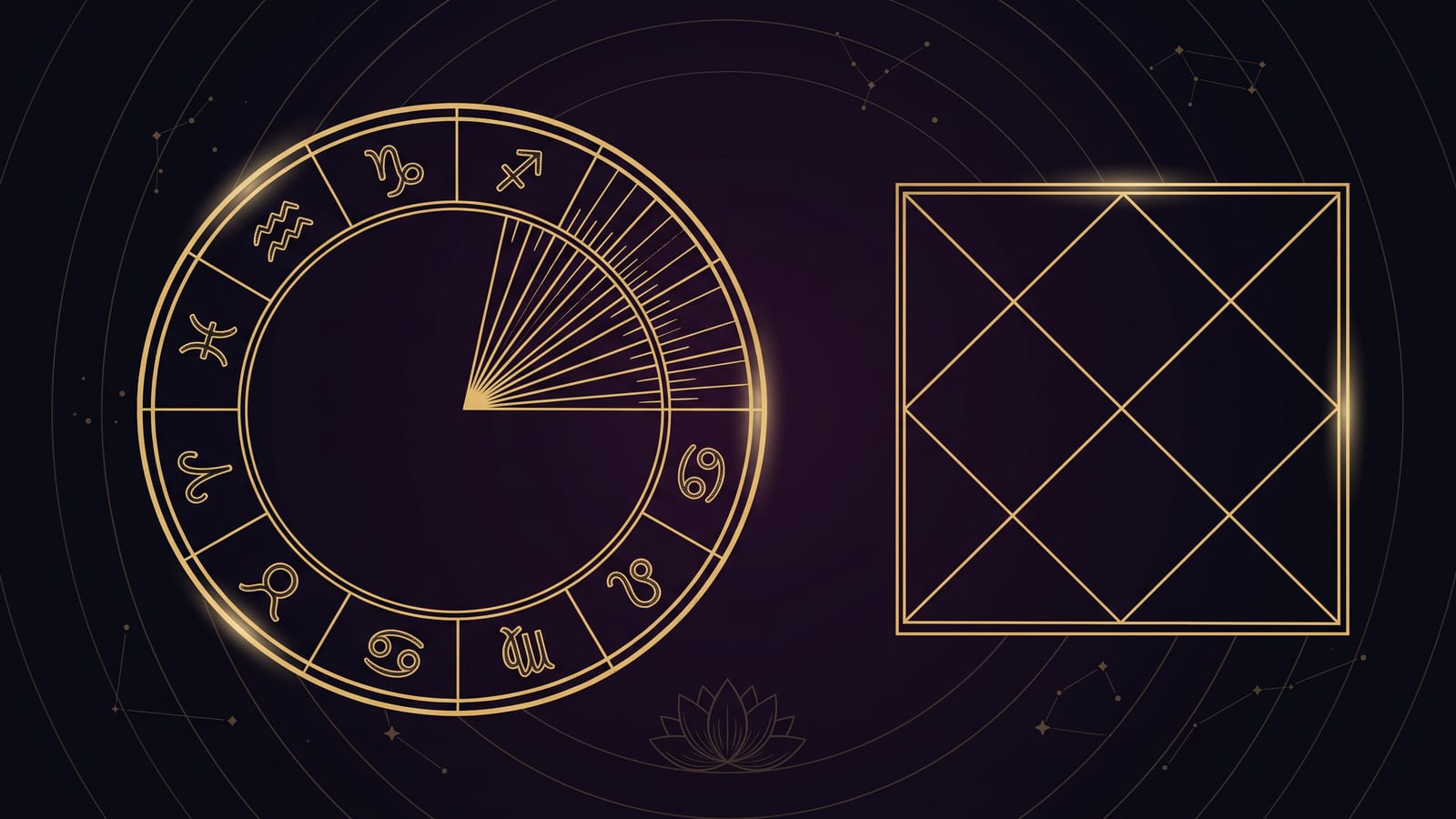
The Navamsa, or D9, is the divisional chart made by splitting every sign of your Kundli into nine equal parts of 3 degrees 20 minutes each. Jyotish reads it as the strength test of the birth chart and as the primary chart for marriage, the spouse and the dharmic shape of later life. It is not a second horoscope. It is the same birth sky, magnified nine times.
That magnification is the whole point, and it is also where most people misread it. Below is how the D9 is built, what it is entitled to say, and what it is not.
What is the Navamsa (D9) chart?
Navamsa means "ninth part". It belongs to a family of charts called vargas, or divisional charts, in which a sign is subdivided and the subdivisions are re-mapped as a fresh chart. The Brihat Parashara Hora Shastra sets out sixteen such schemes, from the D1 Rashi chart down to the D60 Shastiamsa (Varga charts).
Of the sixteen, the Navamsa is by far the most used. Classical texts assign it to the spouse, to marriage and to dharma, and in practice a Jyotish reading of any consequence checks the D9 before it commits to a judgement about a planet. A graha that looks commanding in the Kundli but collapses in the Navamsa is a promise that tends not to deliver. The reverse is also true, and often kinder: a modest looking planet that is dignified in D9 usually gives its results later, quietly, and more durably.
If the vocabulary here is new, start with what the birth chart itself covers in what your Kundli actually reveals, then come back.
How is the Navamsa chart calculated?
A sign is 30 degrees. Divided by nine, each Navamsa is 3 degrees 20 minutes. Twelve signs at nine parts each gives 108 Navamsas in the full zodiac.
The only real rule to remember is where the counting starts, and it depends on the nature of the sign:
- Movable signs (Aries, Cancer, Libra, Capricorn): count begins from that sign itself.
- Fixed signs (Taurus, Leo, Scorpio, Aquarius): count begins from the 9th sign from it.
- Dual signs (Gemini, Virgo, Sagittarius, Pisces): count begins from the 5th sign from it.
So the nine Navamsas of Aries, a movable sign, run like this:
| Navamsa | Degrees within the sign | Navamsa sign |
|---|---|---|
| 1 | 0°00' to 3°20' | Aries |
| 2 | 3°20' to 6°40' | Taurus |
| 3 | 6°40' to 10°00' | Gemini |
| 4 | 10°00' to 13°20' | Cancer |
| 5 | 13°20' to 16°40' | Leo |
| 6 | 16°40' to 20°00' | Virgo |
| 7 | 20°00' to 23°20' | Libra |
| 8 | 23°20' to 26°40' | Scorpio |
| 9 | 26°40' to 30°00' | Sagittarius |
A worked example: Venus at 12°10' Aries falls in the fourth segment, 10°00' to 13°20'. Its Navamsa sign is therefore Cancer, where Venus sits uncomfortably. In the Kundli that Venus looks fine. In the D9 it has something to prove.
Taurus, being fixed, starts its count from Capricorn, so a planet in the first 3°20' of Taurus takes Capricorn as its Navamsa sign. Gemini, being dual, starts from Libra. Do this for every graha and for the Lagna degree, arrange the results in a fresh twelve house grid, and you have the Navamsa chart. Any competent software does it in a second, but knowing the mechanism is what stops you from treating the output as a black box.
Why is one Navamsa the same as one nakshatra pada?
Because the two divisions are the same arithmetic seen from different ends. There are 27 nakshatras, each divided into four padas, which gives 108 padas, each 3 degrees 20 minutes wide. The 108 Navamsas and the 108 padas therefore share identical boundaries.
This is not a coincidence, it is the reason the D9 carries the weight it does. Your Moon's pada already drives your entire Vimshottari Dasha timeline, and the same unit reappears as the Navamsa. It is also why pada based Guna Milan and the D9 tend to agree with each other. The nakshatra layer is covered in full in what a nakshatra is and how all 27 work.
What does the D9 show that the Kundli does not?
| Rashi chart (D1) | Navamsa (D9) | |
|---|---|---|
| Built from | The whole sign, 30 degrees | A ninth of a sign, 3°20' |
| Shows | Events, circumstances, the promise | Strength, durability, the fulfilment |
| Governs | Body, life as lived outwardly | Spouse, dharma, inner and later life |
| Marriage use | Whether and roughly when | Quality, character of the partner, endurance |
| Read alone? | Yes, it is the primary chart | Never, only against D1 |
| Birth time sensitivity | About 2 hours per Lagna sign | About 13 minutes per Navamsa |
The clean way to hold the distinction: D1 states the promise, D9 tests whether it holds. Timing still belongs to the Dasha system, not to the D9.
What is Vargottama and why does it matter?
A graha is Vargottama when it occupies the same sign in the birth chart and in the Navamsa. Classically that is treated as a mark of unusual stability, because the planet keeps its character under magnification instead of changing footing. Because of the counting rule, Vargottama can only occur in three places:
- the first Navamsa of a movable sign, 0°00' to 3°20'
- the fifth Navamsa of a fixed sign, 13°20' to 16°40'
- the ninth Navamsa of a dual sign, 26°40' to 30°00'
The Lagna can be Vargottama too, and when it is, the personality and the life direction tend to read as one thing rather than two.
How is the Navamsa read for marriage?
Marriage is the D9's best known use, and the sequence a traditional reading follows is fairly settled:
- The Navamsa Lagna and its lord. This sets the frame, exactly as the Lagna does in the Kundli. If you have not met the house framework yet, see the 12 houses in a Kundli.
- The 7th house of the D9, its occupants and its lord. Read for the character and steadiness of the partnership rather than for a date.
- Venus in a man's chart, Jupiter in a woman's chart. These are the classical karakas for spouse, and their Navamsa dignity carries more weight than their Rashi dignity.
- The D1 7th lord, seen in D9. This is the cross check that ties the two charts together and stops the D9 being read in isolation.
Note what this is not. Guna Milan, the 36 point compatibility score, is calculated from the Moon's nakshatra in each chart and is a separate procedure altogether. A Navamsa reading and a Guna score answer different questions, and a careful astrologer runs both. The matching side is set out in Kundli matching for marriage.
What are the common mistakes when reading a D9 chart?
Reading it as a standalone horoscope. The Navamsa has no events of its own. It refines the birth chart and cannot manufacture a result D1 never offered.
Trusting a rough birth time. Thirteen minutes of clock time is one Navamsa. If your time came from family memory rather than a record, expect an astrologer to rectify it against known events before drawing conclusions from the D9.
Believing that life "switches" to the D9 after thirty. This is a popular saying, not a Parashari rule. The tradition uses the Navamsa throughout the life as a strength measure, and it is the Dasha sequence, described in the Vimshottari Dasha system, that governs when a result ripens.
Reading a bad D9 as a verdict. A weak Navamsa placement describes a pressure point and the effort a matter will demand. It is a diagnosis, not a sentence, and the classical response is remedial: a mantra, a discipline, a charity, a considered decision about timing. Nothing in Jyotish is offered as guaranteed prediction.
Anita reads charts in the classical Parashari method described by Parashara (Brihat Parashara Hora Shastra), which means the Navamsa is checked as a matter of course, not sold as an extra. You can see what each reading covers on the services page.
Frequently asked questions
- What is the Navamsa or D9 chart in simple terms?
- The Navamsa is a divisional chart made by cutting each of the twelve signs of your Kundli into nine equal parts of 3 degrees 20 minutes. The sign that a planet's ninth part falls in becomes its Navamsa sign. It is read as the strength test of the birth chart and as the main chart for marriage, the spouse and the dharmic direction of later life.
- How is the Navamsa chart calculated?
- Divide the 30 degrees of a sign into nine parts of 3 degrees 20 minutes, then count. For a movable sign the count starts from that sign itself, for a fixed sign it starts from the 9th sign from it, and for a dual sign it starts from the 5th sign from it. Across the whole zodiac this gives 108 Navamsa segments, exactly the same boundaries as the 108 nakshatra padas.
- Is the D9 chart more important than the birth chart?
- No. The Rashi chart (D1) remains the primary chart, because that is where events, houses and promises are read. The Navamsa refines and tests what D1 has already promised. A well placed planet in D9 cannot create a result the birth chart never offered, and reading D9 as if it were a second, separate horoscope is the most common beginner error.
- What does Vargottama mean?
- A graha is Vargottama when it occupies the same sign in the birth chart and in the Navamsa. Classically this is treated as a mark of stability and strength, because the planet keeps its character under magnification. It happens in the first Navamsa of a movable sign, the fifth Navamsa of a fixed sign and the ninth Navamsa of a dual sign.
- How accurate does my birth time need to be for a D9 chart?
- More accurate than for the Kundli alone. The Lagna moves roughly one degree every four minutes, so a Navamsa segment of 3 degrees 20 minutes passes in about thirteen minutes of clock time. An error of a quarter of an hour can therefore change your Navamsa Lagna completely, which is why an astrologer will often ask about recorded events to rectify a doubtful birth time.