
Which Finger, Which Day: How to Wear a Gemstone in 7 Steps
2026-10-12 · 10 min read
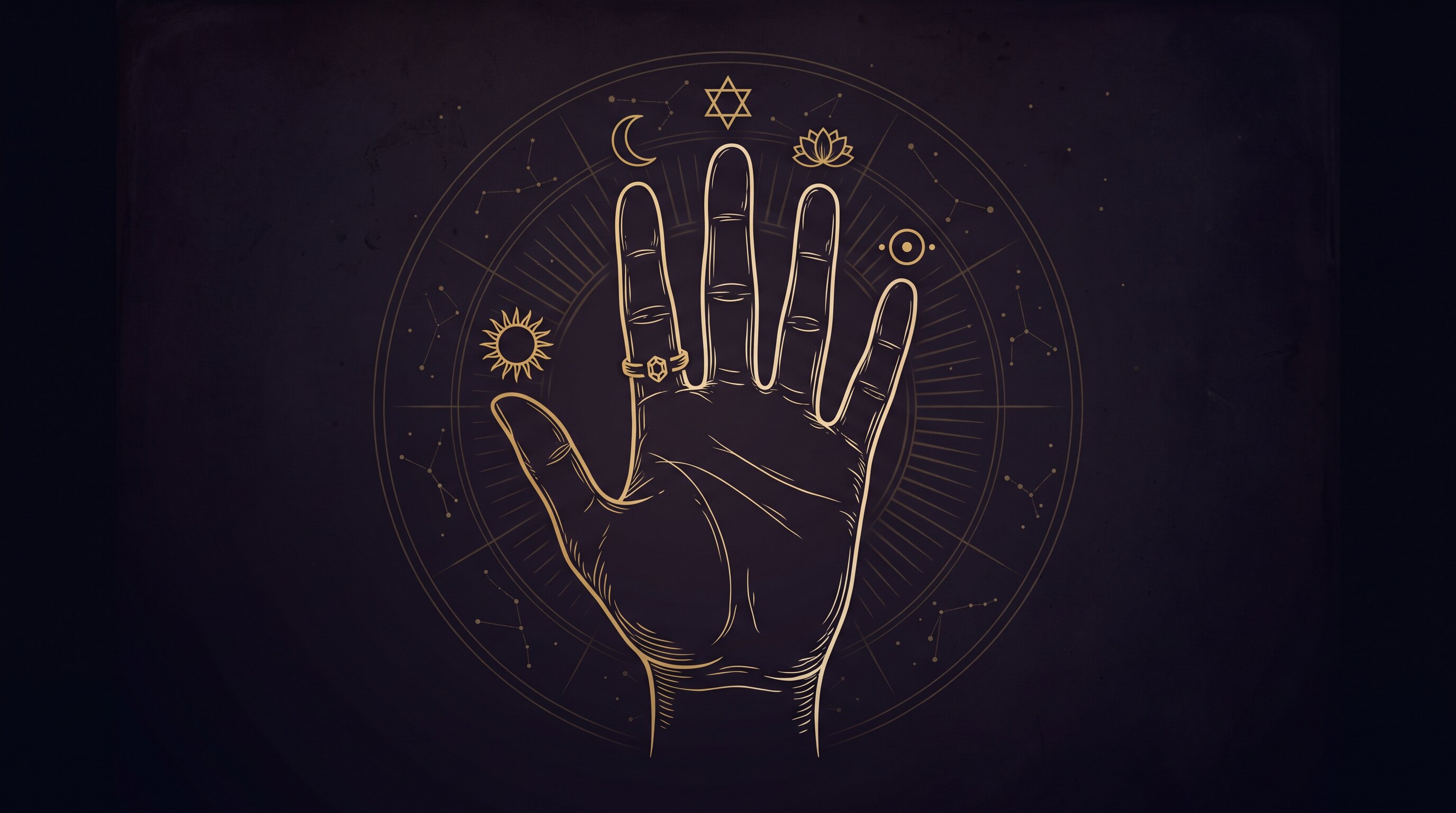
The finger is decided by the planet, not by the stone or its colour. Index is Jupiter, middle is Saturn, ring is the Sun, little is Mercury, thumb is Venus. The stone is set in its planet's metal with an open back, cleansed, dedicated with 108 repetitions of the planet's beej mantra, and first put on in the morning of that planet's own weekday in the waxing fortnight.
That sequence is the whole procedure. What follows is why each finger belongs to the graha it does, how to pick the hour and not only the day, and the pairing rules that matter more than most people wearing two rings realise.
A note before any of it. This post assumes a stone has already been chosen for your chart by someone who read it. If that has not happened, start at do gemstones really work in Vedic astrology instead, because wearing the right stone correctly matters far less than not wearing the wrong one beautifully.
Which finger belongs to which planet?
Five fingers carry five grahas. This mapping comes from the hand as it is read in the Indian tradition, and it is the reason the finger is fixed before the stone is even bought.
| Finger | Graha | Its gemstone | What the finger governs |
|---|---|---|---|
| Index (tarjani) | Guru (Jupiter) | Yellow sapphire, pukhraj | Wisdom, teachers, faith, counsel |
| Middle (madhyama) | Shani (Saturn) | Blue sapphire, neelam | Discipline, duty, patience, karma |
| Ring (anamika) | Surya (Sun) | Ruby, manik | Vitality, authority, confidence |
| Little (kanishtha) | Budh (Mercury) | Emerald, panna | Intellect, speech, trade |
| Thumb | Shukra (Venus) | Diamond, heera | Will, desire, comfort |
That leaves four grahas without a finger of their own: the Moon, Mars, Rahu and Ketu. They borrow, and they borrow from a natural friend rather than at random. This is the part most guides state as a bare rule without explaining it.
- Pearl (moti), for the Moon, goes on the little finger, because the Moon and Mercury are natural friends.
- Red coral (moonga), for Mars, goes on the ring finger beside the Sun. Mars and the Sun are natural friends and both are fiery, so the finger is shared comfortably.
- Hessonite (gomed), for Rahu, goes on the middle finger, since Rahu is widely treated as Saturn-like in its effects.
- Cat's eye (lehsunia), for Ketu, goes on the ring finger or the little finger, depending on the school. Ketu is read as Mars-like, which is the reasoning behind the ring finger.
The thumb is worn least often. Venus more commonly takes the middle or ring finger, with the thumb reserved for practitioners who work with it deliberately.
Which hand should the ring go on?
The usual convention is the right hand for men and the left for women. It is a convention, not a classical injunction, and it varies by region and family custom. A large number of practitioners simply use the working hand, on the reasoning that the stone stays in contact with the skin through the day.
What is not optional is the finger. A ruby on the middle finger is not a ruby worn mildly, it is a ruby aimed at Saturn's finger, which is the opposite of the intent. If your astrologer has named a hand, follow that instruction.
Which day and hour should you first wear it?
Each stone is begun on the weekday ruled by its own planet. The day is only the first filter, though, and the ones after it are what separate a considered start from an approximate one.
| Graha | Gemstone | Metal | Day to begin | Beej mantra (108 times) |
|---|---|---|---|---|
| Surya (Sun) | Ruby, manik | Gold or copper | Sunday | Om Hraam Hreem Hraum Sah Suryaya Namah |
| Chandra (Moon) | Pearl, moti | Silver | Monday | Om Shraam Shreem Shraum Sah Chandraya Namah |
| Mangal (Mars) | Red coral, moonga | Gold or copper | Tuesday | Om Kraam Kreem Kraum Sah Bhaumaya Namah |
| Budh (Mercury) | Emerald, panna | Gold or silver | Wednesday | Om Braam Breem Braum Sah Budhaya Namah |
| Guru (Jupiter) | Yellow sapphire, pukhraj | Gold | Thursday | Om Graam Greem Graum Sah Gurave Namah |
| Shukra (Venus) | Diamond, heera | Silver or platinum | Friday | Om Draam Dreem Draum Sah Shukraya Namah |
| Shani (Saturn) | Blue sapphire, neelam | Silver or panchdhatu | Saturday | Om Praam Preem Praum Sah Shanaye Namah |
| Rahu | Hessonite, gomed | Silver or panchdhatu | Saturday | Om Bhraam Bhreem Bhraum Sah Rahave Namah |
| Ketu | Cat's eye, lehsunia | Silver or panchdhatu | Thursday | Om Straam Streem Straum Sah Ketave Namah |
Three further conditions on the timing, in order of how much they matter:
- The waxing fortnight (shukla paksha). Anything begun as a discipline is started on a rising Moon. A gemstone is a discipline you intend to keep, so the bright half of the lunar month is preferred over the dark half.
- The morning, in the planet's own hora. The day is divided into twenty four planetary hours, and the first hora after sunrise always belongs to the lord of that weekday. So the hour after sunrise on Thursday is Jupiter's day and Jupiter's hora at once. That is the cleanest window available without a custom calculation.
- A nakshatra belonging to the graha. Where it can be arranged, the first wearing is set in one of the planet's own three lunar mansions. If you want the underlying framework, the 27 nakshatras covers how each graha owns three of them, and what a muhurat is explains how a window like this gets chosen in the first place.
Only the first wearing is timed. After that the stone is simply kept on, and you are not rescheduling anything.
How do you wear a gemstone, step by step?
Seven steps, in order. Steps one to three happen before the day arrives.
- Confirm the planet, not just the stone. Know which graha the stone is for, which houses that graha rules in your chart, and why strengthening it is appropriate now. House rulership is what makes a planet functionally helpful or not, which the 12 houses in a Kundli sets out, and the running period decides what is actually live, which is the job of the Vimshottari Dasha.
- Get the metal and the setting right. Use the metal from the table. Have the back of the stone left open so it rests directly against the finger. A closed setting is the single most common fault in ready made rings.
- Fix the weight before you shop. The common convention is roughly one ratti for every twelve kilograms of body weight, with most prescriptions landing between about five and seven ratti. One ratti is close to 0.91 carat. Decide the number with your astrologer, then hold to it, because weight is where upselling happens.
- Cleanse the ring on the morning itself. Soak it briefly in raw milk or Gangajal, or in panchamrit where that is the family custom, then rinse in clean water. The practice of examining and preparing a gem is old: Varahamihira gives it a full chapter, the Ratna Pariksha, in the sixth century Brihat Samhita.
- Dedicate it with the mantra 108 times. Bathe, sit facing east, hold the ring, and recite the beej mantra from the table 108 times. Light a lamp and an incense stick if that is your household practice. This is the step that turns an ornament into a remedy in the eyes of the tradition.
- Put it on in the chosen window. Right hand or left as advised, on the correct finger, during the morning hora on the planet's day.
- Keep it on. Tradition holds that a stone settles over several weeks, so it is worn continuously rather than on occasions. Remove it only to clean it.
Which gemstones should never be worn together?
Two stones on one hand are two grahas asked to work together. If those grahas are natural enemies, the tradition does not combine them. The authority here is the classical table of natural friendship, naisargika maitri, which the standard texts enumerate directly: Mantreswara's Phaladeepika lists each planet's natural friends, neutrals and enemies in its second chapter.
Read off that table, the pairs to avoid are these.
| Stone | Not worn with | Why |
|---|---|---|
| Ruby (Sun) | Blue sapphire, diamond, hessonite, cat's eye | Venus and Saturn are the Sun's natural enemies |
| Pearl (Moon) | Blue sapphire, diamond, hessonite | Venus and Saturn are the Moon's natural enemies |
| Red coral (Mars) | Emerald, blue sapphire, diamond | Mercury is Mars's enemy, and Mars is Saturn's |
| Emerald (Mercury) | Pearl, red coral | Mercury and the Moon are mutual enemies |
| Yellow sapphire (Jupiter) | Emerald, diamond | Mercury and Venus are Jupiter's natural enemies |
| Blue sapphire (Saturn) | Ruby, pearl, red coral | The Sun, Moon and Mars are Saturn's enemies |
The reliable pairings are the friendly ones: ruby with pearl, ruby with yellow sapphire, yellow sapphire with red coral, emerald with diamond, blue sapphire with emerald. Even then, two stones at once is more than most charts need. One well chosen stone, worn properly, is the normal prescription.
What should you expect in the first few weeks?
Honestly: nothing dramatic, and you should be suspicious of anyone who promises otherwise. Jyotish offers a gemstone as support for a planet, not as a lever on events. A chart is a diagnosis, not a sentence, and a stone is one of the gentler things done about it.
The tradition does ask you to pay attention, and its caution is worth keeping: if the weeks after starting a stone feel consistently disturbed, take it off and go back to the astrologer. That is not failure, it is the test working. A remedy you have been told you cannot remove has stopped being a remedy.
Three mistakes account for most of the trouble people run into:
- A strong stone bought without a chart. Blue sapphire, ruby and yellow sapphire are the three to never buy on a general recommendation or a sun sign.
- A treated or synthetic stone sold as natural. Jyotish quality means natural and untreated. Heated, glass filled and lab grown stones are ordinary in the market. Ask for a report from a recognised laboratory, such as GIA.
- A stone prescribed for a health problem. Gemstones are traditional guidance, not treatment, and they do not replace a doctor. Anyone who tells you otherwise is selling, not reading.
If you are weighing a stone against the cheaper remedies first, that ordering is covered in the gemstone post, and the consultations themselves are listed on the services page.
Frequently asked questions
- Which finger is a yellow sapphire worn on?
- Yellow sapphire, or pukhraj, is worn on the index finger, because that finger is assigned to Jupiter and pukhraj is Jupiter's stone. It is traditionally set in gold with the back of the stone left open, and first worn on a Thursday morning in the waxing fortnight.
- Which hand should men and women wear a gemstone on?
- The common convention is the right hand for men and the left for women, but schools differ and many practitioners simply use the working hand. The finger matters far more than the hand. If your astrologer specifies a hand, follow that instruction rather than a general rule.
- Does the day you first wear a gemstone actually matter?
- In Jyotish practice, yes. A stone is begun on the weekday ruled by its own planet, in the morning, during the waxing fortnight, because the whole point of a muhurat is to start a discipline when the planet concerned is prominent. It is the first wearing that is timed. After that the stone is simply kept on.
- Which gemstones should never be worn together?
- Stones of planets that are natural enemies are not combined. In practice that rules out ruby with blue sapphire or diamond, pearl with blue sapphire or diamond, red coral with emerald, and yellow sapphire with emerald or diamond. The reason is the classical table of natural planetary friendship, not the stones themselves.
- Do I have to chant a mantra for a gemstone to work?
- Tradition prescribes the planet's beej mantra 108 times at the first wearing, and it is the standard practice across schools. It is treated as the act that dedicates the stone to the graha. A gemstone is offered as guidance and support, never as a guaranteed outcome, and no mantra count changes that.