
How to Read Your Kundli: A 7 Step Beginner's Guide to Your Birth Chart
2026-08-20 · 8 min read
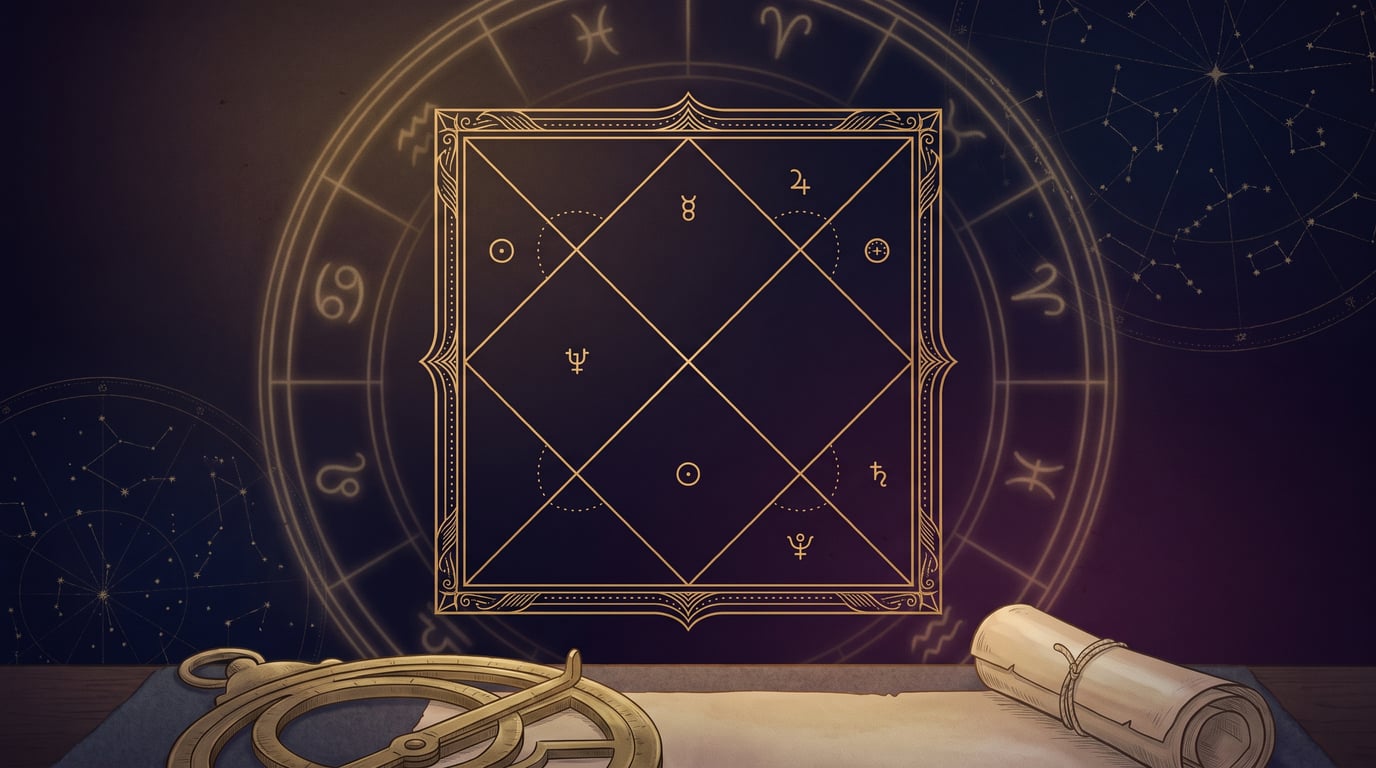
To read your Kundli, work in a fixed order: find your Lagna (the ascendant, which becomes the 1st house), then your Moon sign and nakshatra, then count the twelve houses from the Lagna, then judge where each planet sits and how strong it is, then check the house lords, and only then look at the running Dasha for timing.
That sequence is the whole skill. Most beginners break it by jumping straight to "Saturn is in my 7th house, is my marriage ruined", with no Lagna, no lord and no Dasha to hold that placement in context. Here is the method, one step at a time.
What do you need before you can read a Kundli?
Three pieces of information, and they must be accurate:
- Date of birth
- Time of birth, as precise as you can get it, ideally from a hospital record or birth certificate
- Place of birth, the town or city, for the correct latitude, longitude and time zone
Birth time is the fragile one. The Lagna moves through all twelve signs in roughly 24 hours, which means it changes sign about every two hours and moves one degree every four minutes. An error of a few minutes near a sign boundary rotates all twelve houses. If your time is genuinely unknown, an astrologer can attempt birth time rectification from known life events, but treat any reading from a guessed time as provisional.
One more thing to fix early: Vedic astrology uses the sidereal zodiac with an ayanamsha correction, so your Kundli Rashi is usually one sign behind the Western sun sign you already know. If that surprises you, read Lagna vs Rashi vs sun sign first.
Step 1: Cast the chart and identify the format
Any reliable Vedic software will cast the chart. What confuses beginners is that the same chart is drawn in two very different styles.
| North Indian chart | South Indian chart | |
|---|---|---|
| Shape | Diamond pattern inside a square | Grid of twelve fixed boxes |
| What stays fixed | The houses. The 1st house is always the top centre diamond | The signs. Meena (Pisces) sits top left, and the signs run clockwise |
| What moves | The signs, written as numbers 1 to 12 in each box | The Lagna, marked with a label or diagonal line |
| Reading direction | Anticlockwise | Clockwise |
| How you find the 1st house | It is always in the same place | It is wherever the Lagna is marked |
Planets are abbreviated: Su (Sun), Mo (Moon), Ma (Mars), Me (Mercury), Ju (Jupiter), Ve (Venus), Sa (Saturn), Ra (Rahu), Ke (Ketu). Some Indian software uses Hindi short forms instead, such as Sū, Cha, Ma, Bu, Gu, Shu, Sha, Ra, Ke. Neither style is better. Learn the one your family astrologer uses.
Step 2: Find your Lagna
In a North Indian chart, the number written in the top centre box is your Lagna Rashi. The signs are numbered in the usual order: 1 Mesha, 2 Vrishabha, 3 Mithuna, 4 Karka, 5 Simha, 6 Kanya, 7 Tula, 8 Vrishchika, 9 Dhanu, 10 Makara, 11 Kumbha, 12 Meena. In a South Indian chart, look for the box marked "Lagna" or "Asc".
The Lagna describes your body, constitution, temperament and the way you meet the world. It also sets the reference frame for everything else, because each house is counted forward from it. The lord of your Lagna sign becomes your Lagna lord, and where that planet sits is one of the single most informative facts in the chart.
Step 3: Find the Moon and note your Janma Rashi and nakshatra
Locate Mo in the chart. The sign it occupies is your Janma Rashi, the Moon sign, which in Indian practice is the sign people actually mean when they ask "what is your Rashi". It describes the emotional temperament and the mind.
The Moon's position also fixes your Janma Nakshatra, one of the 27 lunar mansions, which is what your naming syllable, your Dasha sequence and most Muhurat calculations run from. If nakshatras are new to you, all 27 lunar mansions are explained here.
Step 4: Count the twelve houses from the Lagna
The house holding the Lagna is the 1st. Count forward in zodiac order for the rest. Each house governs a department of life:
| House | Governs | House | Governs |
|---|---|---|---|
| 1st | Body, self, temperament | 7th | Marriage, spouse, partnerships |
| 2nd | Wealth, speech, family | 8th | Longevity, upheaval, hidden matters |
| 3rd | Courage, siblings, effort | 9th | Fortune, dharma, father, teachers |
| 4th | Mother, home, property | 10th | Career, status, action |
| 5th | Children, intelligence, education | 11th | Income, gains, elder siblings |
| 6th | Illness, debt, opposition, service | 12th | Expenditure, foreign lands, moksha |
Now write down, in plain language, which planet sits in which house. That single list is most of what a chart tells you. The full significations of each bhava, along with the natural karaka for each, are set out in our guide to the 12 houses.
Step 5: Judge whether each planet is comfortable
A planet in a house is not a verdict on its own. The same planet gives very different results depending on the sign it occupies. Classical Jyotish, following the Brihat Parashara Hora Shastra, grades this as dignity:
| Graha | Exalted in | Debilitated in | Own sign(s) |
|---|---|---|---|
| Sun | Mesha | Tula | Simha |
| Moon | Vrishabha | Vrishchika | Karka |
| Mars | Makara | Karka | Mesha, Vrishchika |
| Mercury | Kanya | Meena | Mithuna, Kanya |
| Jupiter | Karka | Makara | Dhanu, Meena |
| Venus | Meena | Kanya | Vrishabha, Tula |
| Saturn | Tula | Mesha | Makara, Kumbha |
Rahu and Ketu own no sign, and the classical texts do not agree on their exaltation, so most practitioners judge them by their sign lord and their house instead. Our guide to Rahu and Ketu covers how they are read.
Two cautions. A debilitated planet is not a curse; several classical conditions can cancel the debilitation. And exaltation is not a guarantee of results either, because a strong planet still has to be well placed for your particular Lagna.
Step 6: Follow the house lords, not just the occupants
This is the step that separates a real reading from an app summary. Every house is ruled by the lord of the sign on it, and the result of a house depends heavily on where that lord has gone.
So for any question, check four things together:
- The planets sitting in the relevant house
- The strength and placement of that house's lord
- The aspects falling on the house
- The natural karaka for that subject, such as Venus for marriage or Jupiter for children
An empty 7th house does not mean no marriage. It means you read the 7th lord and Venus instead.
Step 7: Check the Dasha that is running now
A chart shows potential. The Vimshottari Dasha system, a 120 year cycle of nine planetary periods allotted according to your birth nakshatra, shows when that potential is likely to surface. A promise the chart does not make cannot be delivered by a Dasha, and a promise the chart does make usually waits for the right Dasha to mature.
Look up your current Mahadasha and Antardasha, then re-read the houses that planet rules and occupies. That is the part of your chart which is live right now. The full sequence and the length of each period are in our Mahadasha guide.
What mistakes do beginners make most often?
- Reading one placement in isolation. No single planet decides an outcome.
- Using an unverified birth time. Everything downstream depends on it.
- Mixing Western and Vedic frames. Sidereal and tropical positions differ by about 24 degrees, so a Western reading pasted onto a Kundli will not hold.
- Treating a dosha as a sentence. Mangal dosha, for instance, has several classical cancellations, as explained in our Mangal dosha guide.
- Ignoring the Dasha. Without timing, a chart is a map with no date on it.
Astrology is offered here as guidance, not as guaranteed prediction. A chart describes tendencies and timing, and what you do with that remains yours.
How long does it take to get good at this?
Most students can identify their Lagna, Moon, nakshatra, house placements and running Dasha within a few weeks of steady study, and that alone makes any consultation far more useful. Reading a chart whole, weighing conflicting yogas and timing events with confidence, is an apprenticeship measured in years.
To see how the pieces fit before you start, begin with what your Kundli actually reveals, and browse the consultations when you would like your own chart read properly.
Frequently asked questions
- How do I read my Kundli step by step?
- Read it in this order: find your Lagna (the 1st house), then the Moon sign and nakshatra, then count the twelve houses from the Lagna, then check where each planet sits and how strong it is, then look at the house lords, and finally check which Vimshottari Dasha is running. Reading a single planet before you have the Lagna and the Dasha is the most common beginner mistake.
- Can I read my own Kundli without an astrologer?
- You can learn to read the structure of your own chart: your Lagna, Moon sign, nakshatra, house placements and current Dasha. That is genuinely useful and worth doing. Judging the combined strength of a chart, weighing conflicting yogas and timing an event reliably takes years of practice, which is where a trained astrologer earns their place.
- What is the first thing to look at in a Kundli?
- The Lagna, or ascendant, which is the sign that was rising on the eastern horizon at your exact moment of birth. It becomes the 1st house, and every other house is counted from it. Change the Lagna and the entire house structure of the chart rotates, so nothing else can be judged correctly until it is fixed.
- Why is exact birth time so important for a Kundli?
- The Lagna moves through the whole zodiac roughly every 24 hours, so it changes sign about every two hours and shifts by one degree every four minutes. A birth time that is wrong by even a few minutes can push the Lagna into the next sign, which rotates all twelve houses and changes almost every conclusion drawn from the chart.
- What is the difference between the North Indian and South Indian chart?
- They are two ways of drawing the same chart. In the North Indian (diamond) chart the house positions are fixed and the signs rotate, so the 1st house is always the top centre box. In the South Indian (square) chart the signs are fixed and the Lagna is marked, so the houses rotate. The planetary positions are identical in both.